
Mutli-fidelity optimization - VF-PI#
import numpy as np
from matplotlib import pyplot as plt

from smt_optim.benchmarks.registry import get_problem

from smt_optim.core import Driver, ObjectiveConfig, ConstraintConfig, DriverConfig, Problem

from smt_optim.surrogate_models.smt import SmtMFCK

from smt_optim.acquisition_strategies import VFPI
Unconstrained 1D optimization#
# high-fidelity function
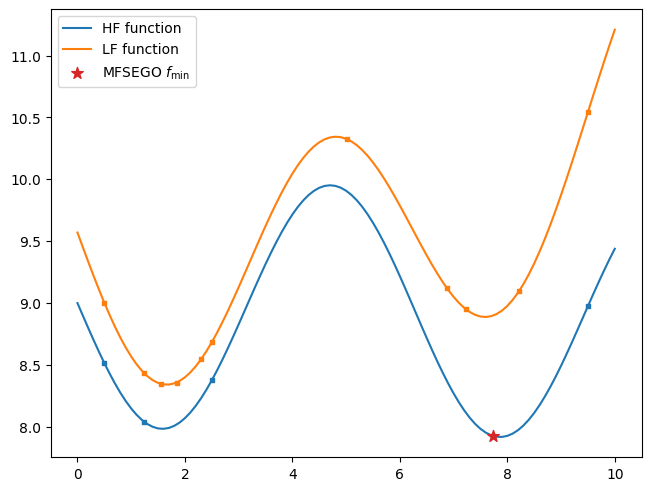
def sasena2002_hf(x):
    return -np.sin(x) - np.exp(x / 100) + 10

# low-fidelity function
def sasena2002_lf(x):
    return sasena2002_hf(x) + 0.3 + 0.03 * (x - 3) ** 2

bounds = np.array([[0, 10]])

x_valid = np.linspace(bounds[:, 0], bounds[:, 1], 101)
y_hf = sasena2002_hf(x_valid)
y_lf = sasena2002_lf(x_valid)
obj_config = ObjectiveConfig(
    objective=[sasena2002_lf, sasena2002_hf],   # multi-fidelity functions must be given in sequential order
    type="minimize",
    surrogate=SmtMFCK,
)


prob_definition = Problem(
    obj_configs=[obj_config],
    design_space=bounds,
    costs=[0.2, 1],                 # Set the cost of sampling each level
)


xt_init = [np.array([[0.5], [2.5], [9.5]]) for _ in range(2)]

opt_config = DriverConfig(
    max_iter = 10,
    max_budget = 10,                # stopping criterion
    xt_init = xt_init,
    verbose = True,
    scaling = True,
    seed=42,
)

optimizer = Driver(prob_definition, opt_config, VFPI)

state = optimizer.optimize()
          iter         budget           fmin           rscv       fidelity        gp_time       acq_time
             1          3.800    8.37621e+00      0.000e+00              1          0.681          0.705
             2          4.000    8.37621e+00      0.000e+00              1          0.745          0.590
             3          4.200    8.37621e+00      0.000e+00              1          0.756          0.446
             4          4.400    8.37621e+00      0.000e+00              1          0.779          0.410
             5          4.600    8.37621e+00      0.000e+00              1          0.817          0.953
             6          4.800    8.37621e+00      0.000e+00              1          0.712          0.420
             7          5.000    8.37621e+00      0.000e+00              1          0.725          0.398
             8          5.200    8.37621e+00      0.000e+00              1          0.690          0.395
             9          6.200    8.04212e+00      0.000e+00              2          0.703          0.404
            10          7.200    7.92735e+00      0.000e+00              2          0.738          0.512
data = state.dataset.export_as_dict()
fidelity_masks = [(data["fidelity"] == lvl).ravel() for lvl in range(state.problem.num_fidelity)]
xt = [data["x"][fidelity_masks[lvl], 0] for lvl in range(state.problem.num_fidelity)]
yt = [data["obj"][fidelity_masks[lvl], 0] for lvl in range(state.problem.num_fidelity)]
sample = state.get_best_sample()

fig, ax = plt.subplots(layout="constrained")
ax.plot(x_valid, y_hf, label="HF function")
ax.plot(x_valid, y_lf, label="LF function")

for lvl in reversed(range(2)):
    ax.scatter(xt[lvl], yt[lvl], 5, marker="s")

ax.scatter(sample.x, sample.obj, 75, marker="*", color="C3", zorder=20, label=r"MFSEGO $f_{\min}$")

plt.legend()
plt.show()
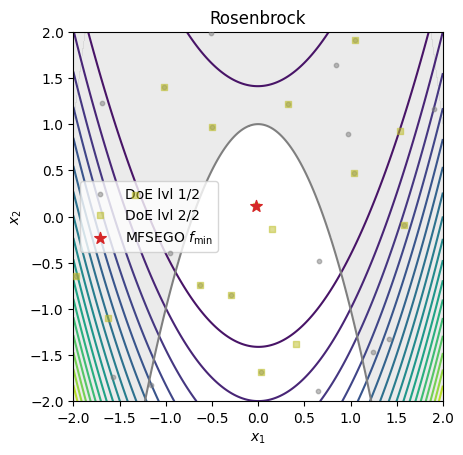
Constrained 2D optimization#
Importing a test function#
problem = get_problem("Rosenbrock")
VF-PI Configuration#
obj_config = ObjectiveConfig(
    problem.objective,
    type="minimize",
    surrogate=SmtMFCK,

)

# configure the constraint
cstr_config = ConstraintConfig(
    problem.constraints[0],
    upper=0.0,                      # g(x) <= 0
    surrogate=SmtMFCK,               # set which GP to model this constraint
)


prob_definition = Problem(
    obj_configs=[obj_config],
    design_space=problem.bounds,
    costs=[0.2, 1],                 # Set the cost of sampling each level
    cstr_configs=[cstr_config],
)


opt_config = DriverConfig(
    max_iter = 30,
    max_budget = 20,                # stopping criterion
    nt_init = 5,
    verbose = True,
    scaling = True,
    seed=42,
)

optimizer = Driver(prob_definition, opt_config, VFPI, strategy_kwargs={"density_penalty": True})

state = optimizer.optimize()
          iter         budget           fmin           rscv       fidelity        gp_time       acq_time
             1          7.200    2.85223e+02      0.000e+00              1          1.813          1.421
             2          7.400    2.85223e+02      0.000e+00              1          2.107          1.314
             3          7.600    2.85223e+02      0.000e+00              1          1.958          1.446
             4          7.800    2.85223e+02      0.000e+00              1          1.904          1.418
             5          8.800    3.20695e+00      0.000e+00              2          1.803          1.374
             6          9.000    3.20695e+00      0.000e+00              1          1.777          1.366
             7          9.200    3.20695e+00      0.000e+00              1          1.917          1.133
             8         10.200    3.20695e+00      0.000e+00              2          1.765          1.245
             9         10.400    3.20695e+00      0.000e+00              1          1.739          1.347
            10         11.400    2.24581e+00      0.000e+00              2          1.758          1.213
          iter         budget           fmin           rscv       fidelity        gp_time       acq_time
            11         12.400    2.24581e+00      0.000e+00              2          1.698          1.439
            12         12.600    2.24581e+00      0.000e+00              1          1.727          1.396
            13         12.800    2.24581e+00      0.000e+00              1          1.871          1.483
            14         13.000    2.24581e+00      0.000e+00              1          1.861          1.434
            15         14.000    2.24581e+00      0.000e+00              2          1.773          1.626
            16         14.200    2.24581e+00      0.000e+00              1          1.873          2.441
            17         14.400    2.24581e+00      0.000e+00              1          1.816          1.540
            18         14.600    2.24581e+00      0.000e+00              1          2.463          1.737
            19         15.600    2.24581e+00      0.000e+00              2          1.954          1.771
            20         16.600    2.24581e+00      0.000e+00              2          2.022          2.061
          iter         budget           fmin           rscv       fidelity        gp_time       acq_time
            21         17.600    2.24581e+00      0.000e+00              2          2.129          1.949
            22         18.600    2.24581e+00      0.000e+00              2          2.000          1.912
            23         19.600    2.24581e+00      0.000e+00              2          2.055          1.708
            24         20.600    2.24581e+00      0.000e+00              2          2.304          1.819
data_x = []
for lvl in range(state.problem.num_fidelity):
    samples = state.dataset.get_by_fidelity(lvl)
    data_x.append(np.empty((len(samples), state.problem.num_dim)))
    for idx, s in enumerate(samples):
        data_x[lvl][idx, :] = s.x

sample = state.get_best_sample(ctol=1e-4)
print(f"best sample = \n{sample}")

X = np.linspace(problem.bounds[0, 0], problem.bounds[0, 1], 201)

XX, YY = np.meshgrid(X, X)

data = np.vstack((XX.ravel(), YY.ravel())).T
z = np.empty(data.shape[0])
c = np.empty(data.shape[0])

for i in range(data.shape[0]):
    z[i] = problem.objective[-1](data[i, :])
    c[i] = problem.constraints[0][-1](data[i, :])

Z = z.reshape(XX.shape)
C = c.reshape(XX.shape)

fig, ax = plt.subplots()

ax.set_title(problem.name)

ax.contour(XX, YY, Z, levels=20)

ax.contourf(XX, YY, np.where(C <= 0, np.nan, C), levels=0, colors="C7", alpha=0.15)
ax.contour(XX, YY, C, levels=[0], colors="C7")

ax.scatter(data_x[0][:, 0], data_x[0][:, 1], 10, color="C7", marker="o", alpha=0.5, label="DoE lvl 1/2", zorder=10)
ax.scatter(data_x[1][:, 0], data_x[1][:, 1], 20, color="C8", marker="s", alpha=0.5, label="DoE lvl 2/2", zorder=20)

ax.scatter(sample.x[0], sample.x[1], 75, c="C3", marker="*", label=r"MFSEGO $f_{\min}$", zorder=30)

ax.set_xlabel(r"$x_1$")
ax.set_ylabel(r"$x_2$")

ax.legend()
ax.set_aspect("equal")
plt.show()
best sample =
======= sample data =======
x =             [-0.02562273  0.10992281]
obj =           [2.24581415]
cstr =          [-0.44438207]
eval_time =     [2.38599023e-06 1.12300040e-06]
------- meta data -------
iter =     10
budget =     11.399999999999999
fidelity =     1
rscv =     0.0
===========================